For most organizations, a professional hi-vis program is more cost-effective than on-premise laundering once garment replacement, labor and compliance tracking are factored in. In-house laundering can work, but only with commercial-grade equipment, strict adherence to care labels and dedicated inspection routines to retire non-compliant gear.
What on-premise laundry means for hi-vis workwear
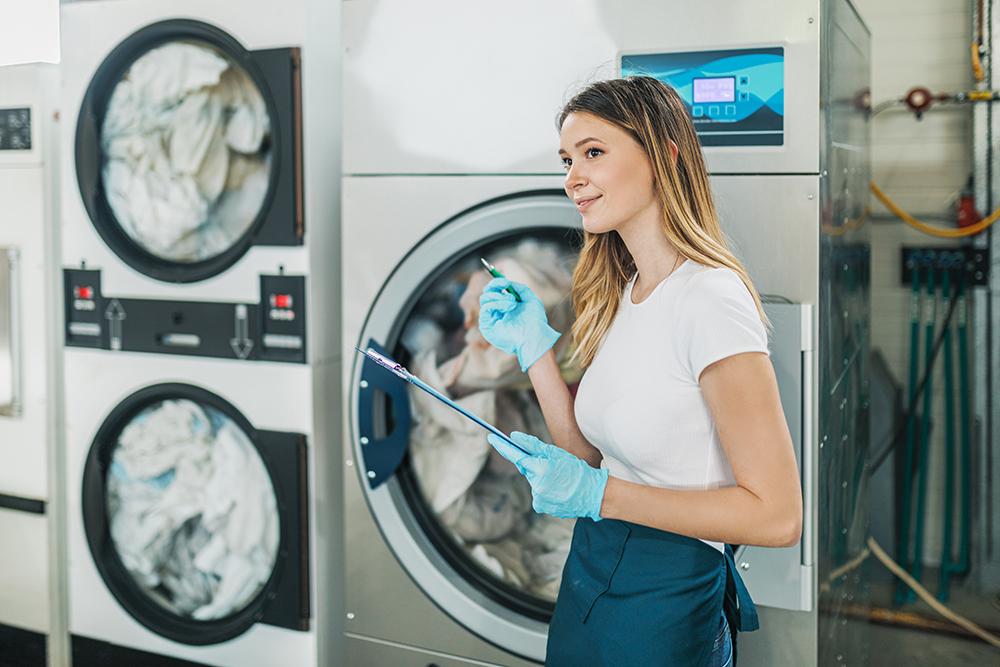
On-premise laundering refers to washing, drying and finishing garments in your own facility rather than outsourcing the service. For a road crew, utility contractor or distribution center, it's usually a commercial washer and dryer in the yard or shop, or hi-vis loads added to a laundry the site already runs.
There are three realistic setups. The first is in-house, where you buy the garments and wash them on your own machines. The second is home laundering, where workers take gear home; it costs the company little, but you give up any say over water temperature, detergent or whether the vest comes back. The third is a professional service, where a uniform rental or laundry provider supplies, cleans, inspects, repairs and replaces garments on a set schedule. For the general case beyond workwear, see why many businesses move from in-house laundry to a commercial service.
Why hi-vis can't go in with everything else
High-visibility garments are personal protective equipment, and their protection comes from two materials that react badly to the way most heavy workwear gets washed. Canvas work pants can take hot cycles and alkaline degreasers for years, while hi-vis can lose real performance within months of the same treatment.
What wears out first: fluorescent color or reflective tape
Fluorescent background fabric keeps workers visible in daylight and at dusk. The dyes behind that lime-yellow or orange-red glow break down with UV exposure, heat and chlorine bleach. Our guide to high-visibility colors covers how each color holds up.
Retroreflective tape handles the night work by sending headlight beams back toward the driver. It relies on tiny glass beads or microprisms held in a binder, and hot water, high-pH detergents, abrasion in an overloaded drum and high dryer heat all weaken that binder. As the beads loosen, the tape can still look silver in daylight while returning far less light at night. Either failure can drop a garment below its rated class, even when the other material is in good shape.
Care labels, rated wash cycles and ANSI/ISEA 107
ANSI/ISEA 107-2020 is the U.S. standard for high-visibility safety apparel. It sorts garments by Type, based on where they're worn (Type O for off-road, Type R for roadway and Type P for public safety), and by Performance Class 1, 2 or 3. For what each class requires and who needs which, see our guide to high-visibility clothing requirements and ANSI classes.
Compliant garments carry a label with care instructions, and many manufacturers also list a maximum number of wash cycles. Tape makers publish their own ratings. 3M, for example, rates some of its Scotchlite reflective tapes for a stated number of industrial wash cycles under the ISO 15797 industrial laundering standard and lists those figures on each product's data sheet. Those ratings assume the wash conditions used in testing, so a garment washed hotter or with harsher chemistry can wear out well before it reaches the number on the label.
No single wash count applies to all hi-vis, so check the label and tape rating on the garments you actually own. The standard sets minimum retroreflective performance for the tape, and confirming a worn garment still meets it takes a retroreflectometer. Without one, a side-by-side flashlight check against a new garment is the practical stand-in.
Oil, grease and other heavy soils
For road, utility and shop crews, oil, tar, diesel and mud usually call for hotter water or stronger degreasers, which are the same conditions that wear down reflective tape. Doing this well in-house means running heavy-soil loads separately so grease doesn't redeposit on clean garments, choosing detergents that lift oil without high alkalinity and dosing them the same way every time.
Oily wash water is its own issue. Your local sewer authority may require a grease trap or pre-treatment before that water goes down the drain, so check before adding these loads. Many crews also wear hi-vis FR garments, which have their own care rules. If that's your setup, read how to wash FR clothing to maintain its effectiveness before mixing them into any load.
In-house vs. professional hi-vis laundering at a glance
Here's how the two approaches compare. The professional column reflects how a typical hi-vis workwear rental program works.
| In-house | Professional service |
|---|---|---|
Upfront cost | Garments, plus machines if you don't own them | Usually little or none; garments are typically included |
Ongoing cost | Labor, utilities, chemistry and replacements | A weekly rate per worker |
Wash temperature and chemistry | Whoever loads the machine | Set process matched to garment specs |
Reflectivity over time | Depends on staff following every label | Typically checked each service cycle |
Inspection and retirement | Your team, if someone owns it | Provider typically repairs or swaps worn gear |
Heavy soils and wastewater | Your chemistry and your drain | Handled at the provider's plant |
Staff time | Several hours a week | Mostly pickup and drop-off |
Turnaround and spare stock | You buy and track the spares | Set number of changes per worker |
Record keeping | Manual, if it happens | Often tracked by the provider |
What on-premise laundry really costs for hi-vis
In-house cost estimates often start and end with the price of a washer. In practice, the larger costs show up in labor and in garments that wear out early. If you're also weighing whether to own garments at all, our article on whether to rent or buy workwear uniforms covers that side of the decision.
Equipment, utilities and chemistry
A commercial washer-extractor and dryer can cost anywhere from a few thousand dollars to more than $20,000, depending on capacity (illustrative range). If you already own machines, the cost is extra wear and earlier replacement once hi-vis loads are added. Then add water, energy, detergent, any dosing system and service calls.
Labor and turnaround
Someone has to collect the gear, sort it by soil level, load it, dry it at the right setting, fold it and hand it back out. Supervisors also lose time chasing vests that went home in a truck. For a mid-sized crew, three to five hours a week is a reasonable starting estimate (illustrative).
Garment replacement and spare stock
Replacement is usually the highest cost and the one budgets most often miss. Garments washed too hot or with the wrong chemistry wear out sooner, and crews need spares to wear while their gear is in the wash.
The most useful way to compare options is cost per wear, meaning the garment's price divided by the number of shifts it lasts while still meeting its class. A $30 shirt that lasts 150 shifts costs 20 cents per wear, while the same shirt retired after 75 shifts costs 40 cents.
Illustrative example: a 40-person road crew
The figures below are hypothetical and only show how the math works, so swap in your own garment prices, wage rates and quotes. The example assumes 40 workers with three Class 3 shirts each (120 garments), washed weekly. In-house, early wear adds 40 replacement shirts a year, and the crew keeps 20 spares on the shelf.
Illustrative annual cost comparison (hypothetical figures)
Cost line | In-house | Professional service |
|---|---|---|
Garments (120 + 40 early replacements at $30) | $4,800 | Included |
Spare stock (20 at $30) | $600 | Included |
Labor (4 hrs/week at $25/hr) | $5,200 | None |
Utilities and chemistry ($40/week) | $2,080 | Included |
Equipment and maintenance (spread over machine life) | $2,300 | Included |
Weekly rental ($6 per worker) | None | $12,480 |
Annual total | $14,980 | $12,480 |
Cost per worker per week | $7.20 | $6.00 |
In this example, in-house comes out about 20% more expensive, and that's before counting time spent inspecting and logging garments or the cost of a worn vest staying in service. If you already own machines with spare capacity, the equipment line drops and the gap narrows to roughly $6.40 versus $6.00 per worker per week.
Want the real numbers for your crew? Get a quote on a managed hi-vis program.
Keeping reflectivity and compliance on track
Whoever does the washing, someone has to decide when a garment is done. In a rental program, that check is typically part of each service cycle. In-house, it falls to your team, and our article on how often PPE should be inspected covers how to set up a routine.
Signs a garment needs to come out of service
Check each garment as it comes back from the wash next to a new one of the same model. Pull it from service if you see any of these:
- Fluorescent fabric that's faded, stained or noticeably duller than a new garment
- Reflective tape that's cracked, peeling, curling or missing sections
- Tape that looks dull under a flashlight when held next to a new garment
- Tears, burns, holes or broken zippers and closures
- Anything that has gone past the care label's or tape maker's rated wash cycles
Who documents it, and why that matters after an incident
Under OSHA 29 CFR 1910.132, and 1926.95 for construction, employers are responsible for providing PPE suited to the hazard and keeping it in reliable condition. After a night-shift incident, one of the first questions is likely to be whether the worker's gear was still doing its job.
A simple log of issue dates, approximate wash counts and retirement dates helps you answer that question. OSHA doesn't prescribe a specific format for hi-vis records, but a clear garment history protects both the company and the crew. Professional services often keep this history as part of the program, while in-house it falls to whoever runs the laundry.
When in-house hi-vis laundering makes sense
In-house can work well for small crews with light soil, such as warehouse or yard staff, especially when most of the gear is Class 1 or Class 2 vests that are inexpensive to replace. It helps if commercial machines are already on site with spare capacity, so you aren't buying equipment, and if one named person owns washing, inspection and retirement.
If two or more of those conditions don't apply, the hidden costs above usually outweigh the savings. For the broader business case beyond hi-vis, see 5 reasons to swap in-house laundry for a commercial service.
What to ask a professional hi-vis laundry service
Providers handle hi-vis differently. Ask these questions before you sign:
- Do you wash to the garment and reflective tape makers' specifications?
- How, and how often, do you check reflectivity and fluorescent color?
- Who pays to repair or replace worn or damaged gear?
- How do you handle heavy oil, grease and tar?
- What's the turnaround, and how many changes does each worker get?
- Can you keep FR and hi-vis FR garments on the right process?
Frequently asked questions
What is an on-premises laundry?
It's laundry your business owns and runs on site rather than outsourcing. For hi-vis workwear, that usually means commercial machines in a shop or yard. You gain control over scheduling, but you also take on the care-label rules, inspection and replacement that keep each garment compliant.
How much does it cost to have work clothes professionally laundered?
Pricing depends on the garment type, how many changes each worker gets, pickup frequency, contract length and whether repairs and replacements are included. Hi-vis and FR garments usually cost more than standard uniforms. The most accurate number comes from a quote based on your crew size and soil level.
Can you wash hi-vis vests in a regular washing machine?
Usually, if the care label allows it, typical guidance is cool or warm water, mild detergent, no chlorine bleach or fabric softener, garments turned inside out and low heat or line drying. The garment's own label takes priority, so check it before the first wash.
How many times can you wash hi-vis clothing?
That depends on the garment and the reflective tape. Many labels and tape data sheets state a rated number of wash cycles, and that figure is the limit. Retire the garment once it passes that number, or sooner if the tape cracks, peels, dulls or the fabric fades.
Does fabric softener ruin reflective tape?
It can. Fabric softener leaves a thin coating that dulls reflective tape and can mute fluorescent fabric, reducing how much light the garment returns. That's why most hi-vis care labels say not to use it.
Do employers have to pay for and clean hi-vis gear?
Under OSHA 29 CFR 1910.132(h), employers generally must pay for required PPE, with a few listed exceptions. Laundering obligations vary by situation and by state, so check the OSHA standard and any state rules that apply to your crew.
Washing hi-vis in-house can keep it compliant, but it takes the right machines, strict care-label discipline and someone who owns inspection. If that's more than your team wants to take on, a managed program handles washing, inspection and replacement for you. Get a quote on a managed hi-vis program.