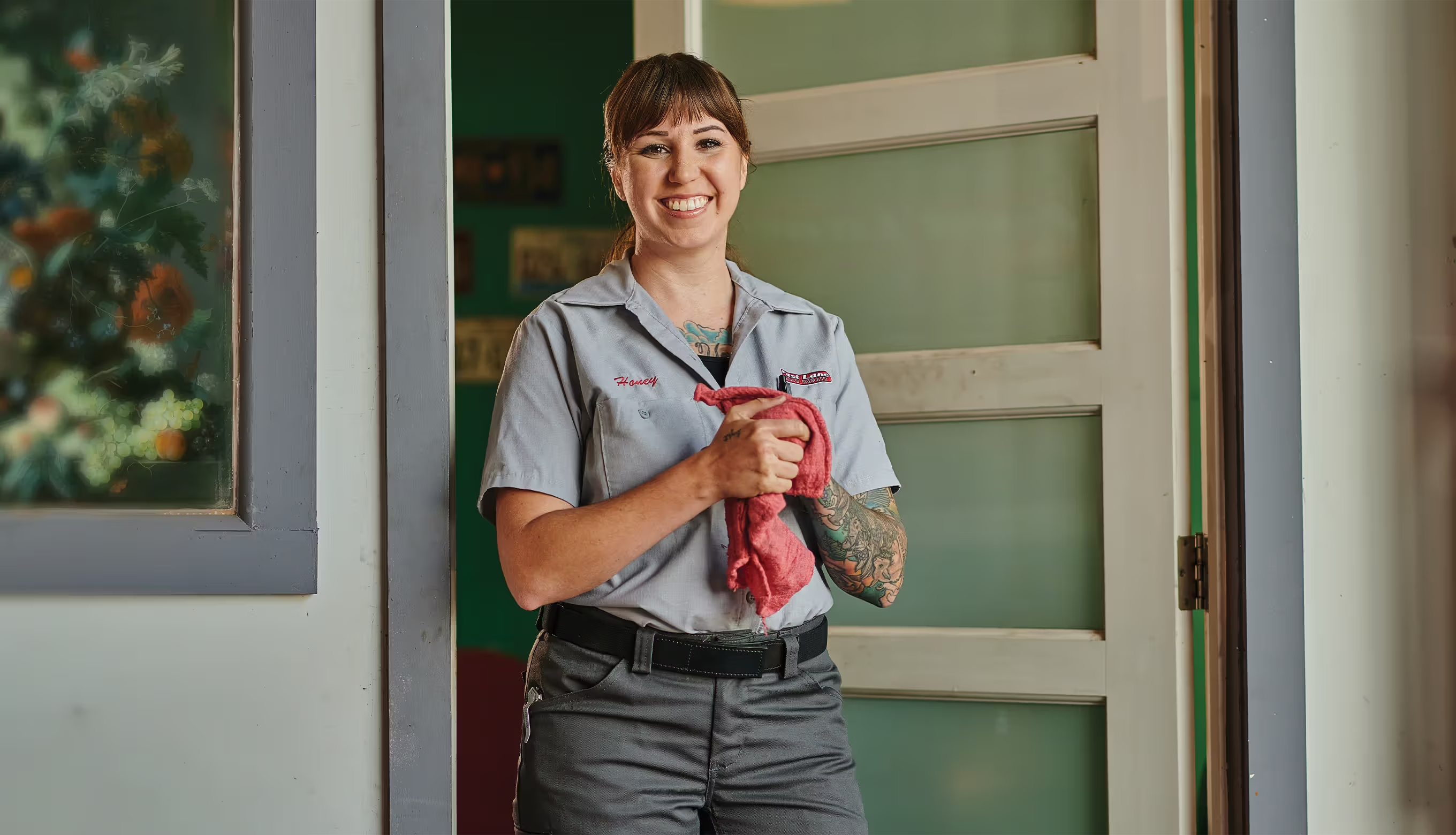
It's Friday afternoon, the towel bin is overflowing and someone suggests putting a washer in the back room. It sounds cheaper than paying a shop towel service every week, and sometimes it is. More often, the savings disappear once you count the labor, the utility bills, the towels that come out still greasy and the questions about what's going down the drain.
For most auto repair shops, outsourcing is the simpler and lower-risk choice. In-house laundering can work, but mainly for shops that already have commercial-grade equipment, approval to discharge the wastewater and staff time to spare. This guide compares both options side by side, walks through what washing towels yourself really involves and shows how to run the numbers for your shop.
In-House vs. Outsourced Shop Towels at a Glance
Factor | Washing in-house | Using a towel service |
|---|---|---|
Upfront cost | Washer, dryer, towel inventory and containers | Usually no equipment purchase; towels are supplied through the program |
Labor | Staff collect, wash, dry, fold and restock | The provider picks up, launders and delivers |
Cleaning results | Household and light commercial machines often leave oil and residue behind | Industrial wash processes built for heavy soil |
Wastewater | Your discharge has to meet local sewer rules | The provider's laundry handles treatment and permits |
Fire risk | Oily towels in bins and dryers are your responsibility | Soiled towels leave on a schedule in closed containers |
Inventory | You buy, count and replace towels | The provider monitors par levels and replaces worn towels |
Cost visibility | Spread across payroll, utilities and supplies | One recurring invoice |
The right answer depends on your volume, equipment and local rules, so the sections below break down each factor. If you want to see how a managed program works first, see this overview of the Alsco Uniforms towel service.
What In-House Shop Towel Laundering Really Involves
Washing a few greasy rags at home and laundering hundreds of shop towels a week are different jobs. Before buying equipment, map out every step and who will own it.
Equipment and Space
Shop towels pick up motor oil, grease, brake fluid and solvents that standard machines aren't designed to remove. Shops that wash in-house typically need commercial or industrial washers and dryers, a dedicated area away from customer spaces and separate storage for clean and soiled towels. Budget for maintenance, repairs and eventual replacement too, along with enough cleaning towels to cover the days a load is still in the machine.
Labor and Turnaround
Someone has to collect the bins, load the machines, dry, fold and restock, usually between other jobs. Even an hour a day is time a tech or service writer isn't spending on billable work. And when laundry slips during a busy week, the bays run short.
Cleaning Results and Towel Life
Towels that come out stiff, streaky or still oily can smear grease on paint, glass and interiors, and techs start grabbing paper instead. Heavy soil also wears towels out faster, so plan for regular replacement rather than a one-time purchase. These are a few of the same reasons businesses swap on-premises laundry for a commercial service.
Wastewater, Waste Rules and Fire Risk
This is where in-house laundering gets complicated, and where most answers online stop short.
What Goes Down the Drain
Wash water from shop towels can carry oil, grease, metals and solvent residue. Many local sewer authorities limit what businesses can discharge, and some require pretreatment or a permit. Check with your local wastewater utility before you install a washer, not after.
EPA's Rule for Solvent-Contaminated Wipes
EPA's solvent-contaminated wipes rule allows reusable wipes sent for laundering to be excluded from hazardous waste regulation when certain conditions are met. Those include keeping them in closed, labeled containers, making sure there are no free liquids, limiting how long they're accumulated and sending them to a laundry whose wastewater discharge is regulated under the Clean Water Act. States can adopt their own versions, so confirm what applies with your environmental contact. Whether washing solvent-soaked towels in your own machine fits those conditions depends on how your discharge is regulated, so get that answer before you start.
Oily Towel Fire Risk
Oil-soaked rags can heat up on their own and ignite, especially when they're piled together. A dryer load of towels that still hold oil adds heat to the problem, and warm towels left in a heap after the cycle can keep heating. Keep soiled towels in closed metal containers, empty them regularly and never leave a dryer full of shop towels unattended. For a broader look at the stakes, see why fire prevention in the workplace matters, and add towel storage to your auto shop safety checklist.
How to Compare the Real Cost
A 50-pack of shop towels at a parts store looks cheap next to a weekly service invoice. But the price of a towel isn't the cost of keeping your bays supplied. Compare the total cost of each option for the same amount of work.
In-House Costs to Count
- Equipment purchase, installation, maintenance and replacement
- Towels, plus replacements as they wear out or go missing
- Water, sewer, electricity and gas
- Detergent and laundry supplies
- Labor for collecting, washing, drying, folding and restocking
- Containers, storage space and any wastewater pretreatment or permits
Outsourced Costs to Count
- The towel charge and how it's billed
- Delivery or service charges
- Loss and replacement charges
- Minimums, contract terms and price adjustments
- Internal time to receive deliveries and check invoices
If you haven't measured how many towels your shop goes through each week, start there. Our shop towel cost guide shows how to track usage and calculate cost per bay.
Do the Math
Here's how the comparison might look for a fictional six-bay shop that uses about 400 towels a week. These numbers are illustrative only. They do not represent pricing from Alsco Uniforms, nor typical market rates, so replace every line with your own figures.
Weekly cost item | In-house | Towel service |
|---|---|---|
Labor (5 hours at $20/hour) | $100 | None |
Utilities and detergent | $25 | None |
Equipment (cost spread over its life, plus upkeep) | $30 | None |
Towel replacement | $15 | Confirm what the program includes |
Service invoice | None | $120 |
Receiving deliveries and checking invoices (30 minutes) | None | $10 |
Estimated weekly total | $170 | $130 |
Change one input, like lower labor because someone already has slack time, and the answer can flip. That's why your own numbers matter more than any rule of thumb.
When In-House Laundering Can Make Sense
- You already own commercial-grade washers and dryers sized for your volume.
- Your local utility has confirmed you can discharge the wastewater, with any required pretreatment in place.
- Your towels are lightly soiled and don't carry solvents.
- Someone has dedicated time to run laundry without pulling techs off the floor.
- Your volume is low enough that a service minimum would go mostly unused.
If several of those aren't true for your shop, outsourcing usually comes out ahead once everything is counted.
When a Shop Towel Service Is the Better Fit
- Your towel volume is high or swings with the season.
- Towels regularly carry solvents, brake cleaner or heavy grease.
- You don't have room for laundry equipment or approval to discharge the water.
- Techs are spending time on laundry instead of billable work.
- You want one predictable invoice and someone else tracking inventory.
A good provider handles pickup, laundering and delivery on a set schedule and adjusts inventory as your volume changes. Before you sign, compare towel type, billing basis, minimums, loss charges and contract terms so you're comparing like for like.
Questions to Ask a Shop Towel Service
- What towel type do you supply, and is it right for our work?
- How do you bill: by allocation, towels delivered or towels processed?
- How often do you pick up and deliver, and what happens if we run short?
- How are lost or damaged towels charged?
- What containers do you provide for soiled towels, and how should we store them?
- What are the contract length, renewal and price-change terms?
Keep Your Bays Stocked Without Running a Laundry
For most auto shops, the real question isn't whether in-house laundering is possible. It's whether it's worth the equipment, time and risk compared with a service that does it for you. Alsco Uniforms towel service picks up soiled towels on schedule, launders them to hygienically clean certified standards and delivers clean towels back, with inventory monitored so you don't run short or overstock. It's part of a wider program for automotive teams that can also cover uniforms, floor mats and first aid. Get a quote with your weekly towel count in hand to see how the numbers compare for your shop.
Frequently Asked Questions About Shop Towel Laundering
How Much Does a Towel Service Cost?
It depends on towel type, weekly volume, delivery schedule, location and how the program bills. Ask providers to quote the same volume and towel type, then compare every line item, including service, loss and replacement charges, not just the per-towel rate.
How Much Do Shop Towels Cost?
Basic shop towels are inexpensive to buy. A 50-pack can cost around $15 at a tool retailer. But the purchase price is only part of the cost if you're also washing, replacing and storing them yourself.
What Is a Towel Service?
A towel service supplies reusable towels, picks up the soiled ones on a regular schedule, launders them and delivers clean replacements. For auto shops, a shop towel service handles the heavy oil and grease that standard laundering struggles with.
Can I Wash Shop Towels in a Regular Washing Machine?
It's not recommended. Household machines aren't built to remove heavy oil and solvents, residue can transfer to other loads and oily towels in a dryer are a fire risk. Wastewater from greasy towels may also be restricted by your local sewer authority.
Is It Cheaper to Wash Shop Towels Yourself?
Sometimes, for low-volume shops with existing equipment and spare staff time. Once you add labor, utilities, equipment, replacement towels and compliance, a service often costs about the same or less. Run both options with your own numbers before deciding.