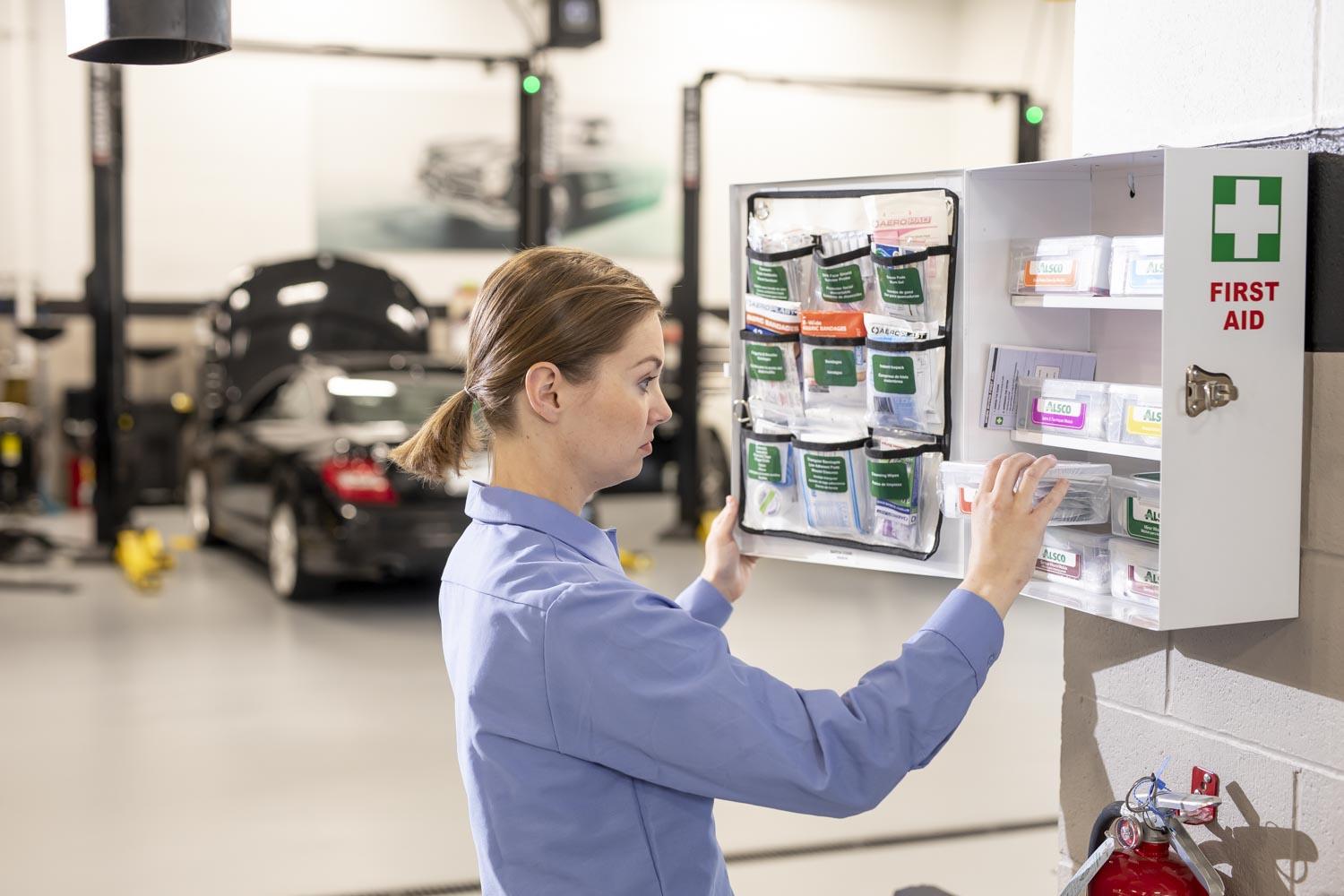
The Occupational Safety and Health Administration mandates that every business must have adequate first aid supplies readily available for employees. Rather than prescribing the same minimum number and type of supplies for every workplace, OSHA requires employers to determine what is adequate based on workplace conditions and hazards.
Beyond that baseline, OSHA also expects employers to determine whether additional first aid supplies are needed based on the specific hazards, size and conditions of the workplace. At construction sites, for example, the extent of the required first aid supplies is much greater than in an office building.
Businesses that do not provide adequate, readily accessible first aid supplies may be out of OSHA compliance and could be subject to citations or penalties. Even a company having its first aid kits too far away for employees to readily access in case of emergency would be in danger of noncompliance. To know what your facility’s first aid kit requirements are, consider what kinds of hazard incidents could be reasonably expected to happen in your workplace based on past precedent and industry standards. This will dictate the appropriate supplies that OSHA expects you to keep on hand.
OSHA’s general first aid kit requirements are therefore based on the needs of the individual workplace rather than a single checklist that applies equally to every employer. Reviewing previous injuries, workplace hazards, workforce size and the location of employees can help determine whether additional supplies or multiple kits are necessary.
First Aid Kit Preparation
OSHA’s definition of first aid is important to note. It can be anything from using bandages to cover a wound to removing intrusive items from the eye with a cotton swab or even giving tetanus immunizations. Of course, not every workplace will have all these issues, but OSHA expects management to be ready for anything that might reasonably happen to workplace employees.
These are some factors to consider when stocking your first aid kit:
- What kinds of injuries usually happen at your workplace? Carry out a risk assessment and create a workplace-specific supply list for your first aid items.
- How long would an emergency medical response take to reach your facility during crucial hours? This is when your facility is at its busiest and when there is the fewest number of people on hand to deal with an emergency.
- What kind of supplies might be needed in an emergency? Employees should know where first aid supplies are located and how to request emergency assistance. Workplace-specific training should also help employees understand the appropriate procedures to follow when an injury occurs.
Workplace size and layout should also factor into your planning. Larger facilities, multi-floor buildings and worksites with employees spread across several areas may need more than one first aid kit so supplies remain readily accessible. Employers can also review their history of workplace injuries and illnesses to identify supplies that may be needed more frequently. For additional preparation guidance, see Alsco Uniforms’ comprehensive guide to workplace first aid kits.
What Should You Put in Your First Aid Kit?
The following list comes from OSHA’s mandatory standard specifically for logging operations. It is not a universal OSHA checklist for every workplace. OSHA’s general-industry standard instead requires employers to provide adequate first aid supplies based on the specific needs and hazards of their workplace.
For logging operations, OSHA requires the following minimum supplies:
- A box of adhesive bandages.
- Two 8 × 10-inch gauze pads.
- A set of standard-sized gauze pads (4 × 4 inches).
- A package of gauze roller bandages, at least 2 inches wide.
- Two triangular bandages.
- Moistened towelettes to clean wounds.
- Scissors.
- Tweezers.
- Adhesive tape.
- Latex gloves.
- Pocket masks, resuscitation bag or another form of resuscitation equipment.
- Instructions for how to request emergency assistance, such as facility-specific information to provide during a 911 call.
These logging requirements should not be interpreted as the minimum required contents for every workplace. For general industry, employers should assess workplace hazards, workforce size, previous injuries and other site-specific factors when determining what supplies and quantities are appropriate.
Additional items that are not required but advisable include the following:
- Hand sanitizer.
- An automated external defibrillator.
- Antibiotic application.
- Antiseptic.
- A breathing barrier.
- A gel-soaked burn dressing.
- A cold pack.
- Eye/skin wash.
- Eye covering with a working means of attachment, such as a strap.
- A first aid guide.
- A tourniquet.
- A sterile pad.
- A splint.
- A trauma pad.
Everyday essentials (Office, Travel, Light-Duty Work)
- Wound care:
- Adhesive bandages in multiple sizes
- Sterile gauze pads
- Medical tape
- Antiseptic or cleansing wipes
- Antibiotic ointment
- Basic tools:
- Scissors
- Tweezers
- Non-latex gloves
- Instant cold pack
- Safety pins
- Support items:
- Triangular bandage for slings or wrapping injuries
- Information:
- A simple first-aid guide
- Emergency contact instructions for your facility
OSHA and ANSI/ISEA First Aid Kit Guidance
OSHA and ANSI/ISEA serve different roles when determining the minimum requirements for first aid kits in the workplace. OSHA Standard 29 CFR 1910.151 requires adequate first aid supplies to be readily available, but it does not establish one universal item-by-item checklist for every workplace. OSHA points employers to ANSI first aid standards as a useful source of guidance for determining minimum contents, particularly for smaller worksites.
ANSI/ISEA standards provide more detailed recommendations for workplace first aid kits, including different levels of supplies based on the type and severity of workplace hazards. This makes a workplace-specific assessment especially important for manufacturing, warehouses, construction and other environments where injuries may be more severe than those typically expected in an office. Employers can also review Alsco Uniforms’ first aid safety tips and best practices when developing their first aid procedures.
First Aid Kit Requirements for Construction Sites
Construction employers have more specific OSHA first aid kit requirements under 29 CFR 1926.50. First aid supplies must be easily accessible when required. The contents of construction first aid kits must also be stored in weatherproof containers with individually sealed packages for each type of item. Employers must inspect kits before they are sent to each job and at least weekly while on the job to make sure used supplies are replaced.
A practical first aid kit checklist for workplace construction sites should include:
- Confirm that first aid supplies are easily accessible.
- Keep the kit in a weatherproof container.
- Check that required supplies remain individually packaged.
- Inspect the kit before it is sent to a job.
- Inspect the kit at least weekly while on the job.
- Replace expended supplies.
- Make sure workers can contact emergency medical services when necessary.
Employers should also consider the types of incidents that are most likely at a particular jobsite. Alsco Uniforms’ guide to common workplace accidents and how to prevent and prepare for them provides additional considerations when assessing workplace injury risks.
Emergency Medical Response and First Aid Personnel
Having supplies available is only one part of OSHA’s first aid requirements. Under the general industry standard, when an infirmary, clinic or hospital is not in near proximity to the workplace, employers must have one or more people adequately trained to provide first aid. Construction employers must similarly make provisions for prompt medical attention before a project begins. Employers should consider how employees will contact emergency medical services and whether responders can quickly identify and reach the worksite. First aid supplies, trained personnel and emergency communication procedures should work together as part of the workplace’s overall emergency response plan.
Emergency Eyewash and Body Flushing Requirements
Some workplaces also require emergency equipment beyond a standard first aid cabinet. Where employees may be exposed to injurious corrosive materials, OSHA requires suitable facilities for quickly drenching or flushing the eyes and body within the work area for immediate emergency use. Businesses working with these materials should therefore evaluate whether eyewash or body-flushing equipment is necessary in addition to standard first aid supplies. Alsco Uniforms offers First Aid & Safety services that include workplace safety products such as first aid cabinets, AED devices and eyewash stations.
Practical First Aid Kit Management
- Make it easy to find: Kits should be clearly labelled, easy to reach, and placed where injuries are most likely to occur.
- Keep it ready: Check supplies on a regular schedule and replace used or expired items right away.
- Train your team: Knowing how to use items like CPR masks, eye wash, or tourniquets is just as important as having them on hand.
First aid supplies should be kept usable and ready when needed, so regularly check expiration dates, packaging and supply levels and replace items when necessary. Keeping a record of purchase and expiration dates can make routine first aid kit inspections easier.
Inspection frequency should reflect the workplace and how frequently supplies are used. Construction sites have a specific requirement to inspect kits at least weekly, while employers in other industries should establish a regular inspection process appropriate for their workplace. During each check, make sure supplies remain accessible, packages are intact and used or outdated items are replaced.
Keep Your Workplace Prepared and Your First Aid Kits Stocked
Meeting workplace first aid requirements starts with understanding the risks employees actually face. Employers should identify likely injuries, provide appropriate supplies, keep kits readily accessible and regularly check that necessary items remain available. Workplace size, staffing levels and facility layout can also affect how many kits and how much first aid equipment are appropriate. Higher-risk or regulated industries may have additional requirements covering kit contents, storage, inspection schedules and emergency equipment.
If you don't want to deal with the busywork, consider a first aid kit service company. At Alsco Uniforms, we know how important first aid is for keeping your employees and customers safe. Ask us how we can ensure that the first aid cabinets at your facility are fully stocked and up to OSHA and ANSI/ISEA requirements. We also offer a full range of facility services like restroom products or floor mats.
Alsco Uniforms is a global leader in commercial laundry, uniform rental, linen services, and facility services, trusted by businesses in 12 countries. With 136+ years of experience, we deliver clean, professional, and reliable service that helps your team show up ready, day after day. Contact us to learn how Alsco Uniforms can help support your workplace first aid and facility needs.
References
1910.266 App A - First-aid Kits (Mandatory). Occupational Safety and Health Administration.