Why facility service schedules aren't one-size-fits-all
Most commercial facilities service floor mats every week or every other week, swap mop heads weekly (daily in healthcare and food service), and restock restroom supplies on a weekly route, with quick daily checks by staff in between. That's the short answer, but the right cadence for your building depends on three things: foot traffic, industry, and season. An office has different rules than a hospital or a commercial kitchen, and wet or winter weather can easily double the dirt and moisture your mats, mops, and other facilities management supplies have to handle. It also helps to know that no single regulation sets one fixed restroom cleaning schedule. OSHA, health codes, and infection control guidance require facilities to stay "clean and sanitary" and stocked, then leave the actual timing up to you, which is exactly where most facilities get it wrong. Below, you'll find a frequency table by facility type, item-by-item guidance, what staff should handle between visits, and how to set up a service program so nothing runs out.
Why service frequency matters for safety and compliance
Start with the floor. A saturated entrance mat or a dirty mop doesn't remove water and grime; it just spreads it around, which turns a cleaning tool into a slip hazard. OSHA's walking-working surfaces standard (29 CFR 1910.22) requires floors to be kept clean and, as far as possible, dry. Restrooms have their own rules, too: OSHA 29 CFR 1910.141 requires toilet facilities to be kept clean and sanitary, with hand washing stations that have running water, soap or a similar cleansing agent, and towels or air dryers. In other words, an empty soap dispenser is a compliance issue, not just an inconvenience.
Here's the catch. Because OSHA doesn't specify a restroom cleaning interval, your written schedule and cleaning log are what show an inspector (or a lawyer after a slip claim) that the facility was actually maintained. Even general cleaning standards for office buildings come back to the same idea: you need to be able to prove the work happened. And there's a less formal audit happening every day, since visitors judge a business by its restroom and its entrance. Missed service usually shows up in customer perception long before it shows up in an inspection report.
Service frequency by facility type
The table below shows typical starting points, not fixed rules. A good facility services program starts with a site walk-through and then adjusts these numbers based on headcount, the number of entrances, and actual traffic counts. Restroom cleaning and restocking, in particular, should follow how many people use the space, not just how many people work there.
Facility Type | Floor Mats | Mop Heads | Restroom Supplies | First Aid Cabinet | Towels & Rags |
|---|---|---|---|---|---|
Office (low to moderate traffic) | Every 2 weeks (weekly in winter) | Weekly | Weekly restock with daily staff checks | Monthly check | As needed |
Retail and high-traffic lobbies | Weekly | Weekly | Weekly or twice weekly | Monthly | Weekly |
Restaurants and food service | Weekly (kitchen anti-fatigue and grease mats may need twice-weekly service) | Weekly at minimum, with daily laundering for kitchen mops | Twice weekly | Monthly | Bar and kitchen towels multiple times per week |
Healthcare | Weekly | Changed per room or per shift (microfiber), laundered daily | Daily stocking | First aid and AED checks monthly | Surgical and cleaning towels per use |
Industrial and manufacturing | Weekly (oil and chemical exposure shortens mat life) | Weekly | Weekly | Monthly, with eye wash stations checked weekly | Shop rags weekly |
Note: High-traffic sites (as a rough rule of thumb, several hundred visitors per day or more), wet seasons, and special events should move one step up in frequency.
How often should floor mats be serviced?
- Weekly or every other week for rental mats: A professional swap doubles as a scheduled inspection. Dirty mats are replaced with clean ones rather than cleaned on site, so you're never stuck with a mat that's only half dry.
- Daily vacuuming between swaps: Mats only work while they still have room to hold dirt and water. Industry estimates consistently find that most of the dirt inside a building is tracked in on shoes, which is why entrance matting should run 12 to 15 feet where space allows.
- Seasonal adjustments: Move to weekly service (or more often) during winter and rainy months. A saturated mat stops trapping water and starts becoming a slip hazard itself.
- Four things to check on every walk-through: Look at position (the mat hasn't shifted), wear (no thin or bald spots), flatness (no curled edges that can cause trips), and cleanliness. These checks line up with most floor mat safety standards, and they take about 30 seconds per entrance.
- Different mats, different needs: Scraper mats outside the door, wiper mats just inside, anti-fatigue mats at workstations, and grease-resistant mats in kitchens all wear at different rates, so they don't always belong on the same schedule.
How often should mops be serviced or replaced?
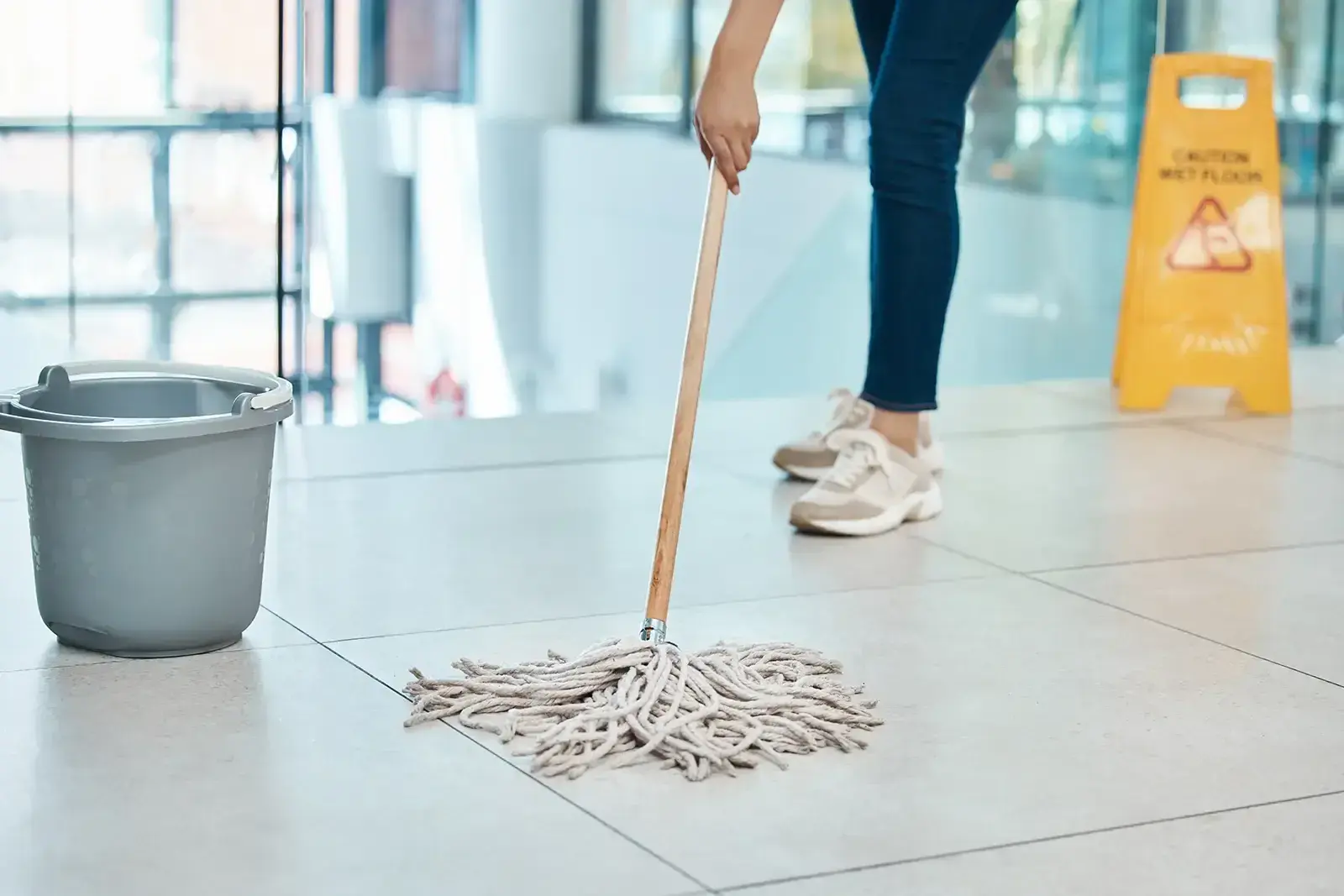
In healthcare and food service, mop heads should be laundered after each day's use. In offices and retail, swap them weekly at minimum. A mop that sits damp in a bucket overnight grows bacteria, then spreads it across the floor on the next pass. Color-coding helps keep that problem contained: a common system uses red for restrooms and high-risk areas, blue for general areas, green for food service, and yellow for healthcare isolation areas. The one rule that never bends is that a restroom mop should never touch a kitchen or patient-care floor.
Material matters, too. Microfiber mop heads pick up more soil and use less water and chemicals than cotton string mops, which is why many healthcare facilities use one microfiber pad per room. Whatever you use, replace (don't just launder) a mop head once it's frayed, matted, discolored, or still smells after washing. A rental program for wet mops and dust mops handles that laundering and replacement cycle for you, so clean heads arrive on schedule and nobody on your team is scrubbing them out in a utility sink. It's one of the simplest ways to keep floor care consistent across every shift.
Restroom cleaning and supply schedule: what to restock and when
Think of restroom cleaning in three layers: what staff handle every day, what your provider restocks every week, and what gets a deeper look once a month.
Daily (or every shift in high-traffic sites)
- Refill soap, hand sanitizer, toilet paper, and paper towels. A good rule of thumb is to restock when supplies hit about half full rather than waiting until they're empty.
- Empty trash and feminine hygiene receptacles before they're full.
- Wipe down sinks, counters, fixtures, and high-touch points like door handles and dispenser levers.
Weekly
- Professional restock of bulk paper, soap, and sanitizer refills through your restroom supplies provider.
- Air freshener refills or cartridge swaps, plus a check on toilet care products like bowl clips and cleaner.
- Floor drains flushed and treated with drain care products to prevent odors and buildup.
Monthly
- Replace urinal screens, since most last about 30 days before they stop deodorizing.
- Check every dispenser for function and replace batteries in automatic units.
- Handle the deeper work: grout, partitions, vents, and behind fixtures.
- Confirm ADA-accessible features (grab bars, accessible-height dispensers, and clear paths) are working and unobstructed. A blocked or broken accessible feature is a compliance issue on its own.
What staff should handle between service visits
1. Run a quick opening and mid-day check
Walk the entrances and restrooms at opening and again at peak traffic. Look at mats, supply levels, wet floors, and odors, and fix small problems before they become complaints.
2. Keep a cleaning log
Record the time, area, task, and initials on a log posted in each restroom or tracked in a facility app. This is your proof of maintenance if a complaint, inspection, or claim ever comes up.
3. Train staff on color-coding and spill basics
Make sure everyone knows which mop goes where, how to post wet floor signs, and who to call when a supply runs out early.
4. Track what runs out before the next visit
If soap or paper towels consistently run low before the route arrives, that's a sign to raise par levels or service frequency. It's a much better fix than having staff make emergency supply runs.
5. Consider simple monitoring tools
Smart dispensers and occupancy sensors can flag low supply levels or high-traffic days. That said, a consistent schedule and accurate par levels solve most stockouts without any new technology.
Industry rules that change the schedule
Some industries don't get much say in how often things are serviced. In healthcare, infection control guidance, including the CDC's environmental infection control guidelines, calls for daily laundering of mop heads and cleaning cloths, strict separation of patient-area and restroom tools, and more frequent restroom service. Linens and towels also need to be laundered to healthcare hygiene standards, which is hard to manage with an on-site washer.
Food and beverage operations and food processing facilities follow health codes based on the FDA Food Code, which requires hand-washing sinks to stay stocked with soap and hand-drying supplies at all times. Inspectors check restrooms and floors, and grease and moisture wear out kitchen mats faster than almost any other environment. Offices and general commercial buildings have more flexibility, but OSHA's sanitation and walking-working surface rules still apply to every workplace, no matter how quiet it is.
Choosing a service model: cost, sustainability, and what to ask a provider
- In-house vs. rental service: Buying mats and mops looks cheaper up front, but it adds labor for laundering, inventory tracking, and replacement. A rental program turns all of that into one predictable recurring cost.
- One provider vs. several: Bundling mats, mops, restroom supplies, first aid, and towels with a single provider means one delivery schedule, one invoice, and one point of contact, instead of coordinating multiple vendors who all show up on different days.
- Sustainability: Ask how items are laundered. Industrial laundering with water recycling, NPE-free detergents, and energy-efficient equipment uses fewer resources than washing mats and mops on site, and a provider should be able to walk you through its sustainability practices.
- Questions to ask a provider: How are frequency and par levels set? What happens if we run out before the next visit? Is pricing flat-rate, and are there any upfront costs? How are damaged or worn items replaced?
Keep your facility clean between every visit
The right service schedule depends on traffic, industry, and season, and the facilities that stay clean and compliant are the ones that set frequency on purpose instead of reacting to stockouts and soggy mats. The easiest way to stick to that schedule is to make it someone else's route. A facility service program sets par levels for mats, mops, and restroom supplies, then delivers, picks up, cleans, and restocks everything on a regular schedule, so your staff only handle restroom cleaning checks and quick daily tasks. Alsco Uniforms is a global leader in commercial laundry, uniform rental, linen services, and facility services, trusted by businesses in 12 countries, with over a century of experience delivering clean, professional, and reliable service that helps teams show up ready, day after day. Our facility services cover floor mats, mops, restroom supplies, first aid and safety, and towels under one schedule and one invoice, with flat-rate pricing and no upfront cost. When you're ready, get a quote for a facility service program built around your traffic and your industry.