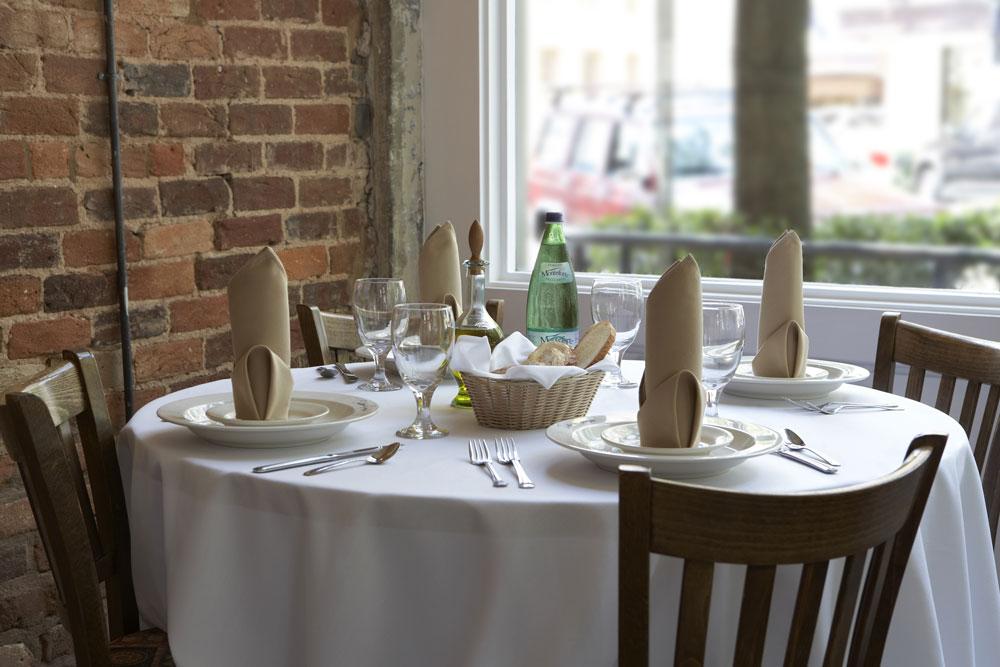
The best commercial linen services for restaurants deliver clean, hygienically processed linens on a schedule you can count on. They keep your par levels right as business changes, and they put their pricing and contract terms in plain writing. A provider’s size and name matter far less than whether it can do those things week after week, so the smartest way to choose is to know exactly what to ask before you sign.
A restaurant linen service takes the napkins, tablecloths, kitchen towels, aprons and chef coats your team goes through every shift, launders them off-site and brings them back on a set schedule. When it works, nobody notices. When it doesn’t, servers are folding mismatched napkins ten minutes before doors open and the line is wiping down stations with whatever towels are left. If you’re still deciding whether to outsource at all, our look at the reasons to swap on-premises laundry for a commercial service covers that bigger question. This guide is for restaurants that have already decided to use a service and want to choose the right one for their kitchen.
What a Restaurant Linen Service Should Include
Most restaurant linen programs cover the textiles that touch both your guests and your kitchen. On the front-of-house side, that usually means tablecloths, napkins and server aprons. In the back of house, it means chef coats, cook shirts, bib aprons and the kitchen towels and bar mops your team reaches for all night. Restaurants usually need both kinds of towel, since bar mops and kitchen towels do different jobs. Many providers can also fold floor mats and restroom supplies into the same weekly visit, which keeps everything on one schedule and one invoice.
The service itself should be complete. A good provider picks up soiled items, launders them, inspects every piece, repairs or replaces anything worn and delivers clean stock back to you. You shouldn’t have to buy inventory, chase replacements or keep a spreadsheet of what’s missing. Because restaurant linens carry grease, food stains and kitchen soils that hotel sheets never see, the wash process should also be built for food service rather than borrowed from hospitality or healthcare.
It’s worth asking early whether a provider rents you the linens or launders linens you already own. In a rental program, the provider owns the inventory and handles replacement as items wear out, which keeps your upfront cost low. With customer-owned goods, you buy the linens and pay the provider to clean and deliver them, which can make sense if you’ve invested in custom colors or premium fabrics. Neither model is right for everyone, and a good provider will explain the trade-offs instead of steering you toward one. It also helps to know what a commercial linen service isn’t. Recurring restaurant programs are built for daily use, so specialty decorative linens for one-time events like weddings usually come from event rental companies instead.
7 Things to Look For in a Commercial Linen Service
1. Deliveries you can set your watch by
Reliability is the whole job. Most restaurants get weekly or twice-weekly deliveries, and a missed or short delivery can leave you scrambling before a Friday rush. Ask each provider how it schedules routes, what its delivery window looks like and what it does when something goes wrong. The answer you want is specific, such as a set delivery window, a way to request an extra drop before a big event and a clear remedy if a delivery slips, rather than a promise to “do our best.”
2. Hygiene standards you can verify
Clean-looking linens aren’t necessarily hygienically clean, and in a dining room that difference matters. Ask how a provider’s wash process is controlled, how it handles heavily soiled kitchen items and whether an outside party has audited the results. Third-party certification is the strongest proof you can get. Alsco Uniforms was the first company in the commercial linen rental industry to earn NSF commercial laundry certification. That process included facility audits and microbiological testing of finished linens to confirm the laundering removes harmful bacteria, so the standard is measured rather than simply claimed.
3. Par levels that match your volume
Your par level is the number of each item you keep on hand between deliveries, plus a cushion for what’s in the wash. Many operators start with enough for what’s in use, what’s at the laundry and what’s on the shelf, then adjust from there. A good provider builds those numbers from your covers, your menu and your delivery schedule rather than handing you a standard package. Just as important, it revisits them when you add a patio, hit a slow season or roll out brunch. If you’re paying for stacks of napkins in January or running short in July, your par levels aren’t working for you.
4. Consistent linen quality
Guests notice a gray napkin or a frayed tablecloth, even when they don’t say anything. Look for a provider that pulls stained and worn items during inspection, before they reach your tables, and keeps color and sizing consistent from one delivery to the next. That consistency matters in the kitchen, too, where a thin, worn towel slows the line down. If table presentation is central to your concept, our buying guide for fine table linens walks through the fabrics and finishes worth asking about.
5. Pricing you can actually read
Most restaurant linen services charge a recurring weekly rate that bundles rental, laundering, delivery and normal replacement. The questions that matter are what that rate includes and what gets billed separately. Lost and heavily damaged items are usually extra, so ask for per-item replacement costs in writing, and find out whether there’s a minimum weekly charge that still applies when business slows down. A quote that answers those questions up front is far easier to budget around than one that leaves them for the first invoice. For a full breakdown of how a rental program compares with doing it yourself, see our guide to restaurant linen service vs. in-house laundry costs.
6. Contract terms you can live with
Restaurant linen contracts often run three to five years, and many renew automatically unless you give notice within a set window. Long terms aren’t a problem on their own, since they’re part of what lets a provider invest in inventory for your account, but you should understand every part of the agreement before you commit. Ask how long the term is, how and when prices can be adjusted, how renewal works and what it costs to leave early. Our guide to restaurant linen rental contracts covers the clauses worth reading line by line.
7. A local team with real backup
Restaurants often weigh a national provider against a local specialist, but the best providers give you the strengths of both. You want a route driver who knows where your back door is and a rep who picks up the phone, along with enough inventory and plant capacity behind them to cover a holiday spike, an unexpected buyout or a second location. That combination is what keeps a small problem from turning into an empty linen shelf on a Saturday night.
How to Compare Restaurant Linen Services Side by Side
Once you have two or three quotes, line them up against the same criteria. Quotes are rarely apples to apples, and the lowest weekly rate can hide gaps in delivery, quality, or contract terms. This table gives you a simple way to compare providers, along with the questions that bring those differences to the surface.
What to compare | What good looks like | Red flags | What to ask |
|---|---|---|---|
Delivery reliability | Delivery on the same day and in the same window every week, with a backup plan for problems | Vague delivery windows, short counts, a different driver every week | What happens if a delivery is missed or short? |
Hygiene standards | A documented wash process for food service with third-party certification such as NSF certification | “We use commercial detergent” and nothing more | Can you show me how your laundering process is audited? |
Par levels | Counts built from your covers, menu and delivery cadence, reviewed as business changes | A flat package that ignores your volume or seasons | How do you set par levels, and how often do you revisit them? |
Linen quality | Consistent color and sizing, with stained or worn pieces pulled before they reach you | Mismatched napkins, frayed hems, uncleaned stains | How are worn or stained items caught and replaced? |
Ownership model | A clear explanation of rental and customer-owned goods, and which one fits your restaurant | Pressure toward one model without explaining the trade-offs | Do I rent the linens, or do you launder linens I own? |
Pricing | One clear weekly charge, with loss and damage fees and any minimum weekly charge listed in writing | Charges you can’t explain, or fees that only show up on the invoice | What’s included in the weekly rate, and what’s billed separately? |
Contract terms | A term length, renewal process, price adjustment policy and exit terms you understand before signing | Automatic renewals buried in the fine print and costly buyout clauses | How long is the term, how can prices change and what does it cost to leave? |
Service and support | A local rep and route driver who know your account and answer quickly | A call center that can’t see your history | Who do I call with a problem? How fast will they respond? |
Is a Restaurant Linen Service Worth the Cost?
For most independent and mid-sized restaurants, yes. Washing in-house rarely costs as little as it looks, because the real cost is spread across payroll, utilities, equipment and replacement linens instead of sitting on one invoice. Here’s a simple example to show how those costs add up.
Picture a 100-seat restaurant washing its own linens. Staff spend about 12 hours a week sorting, washing, drying and folding, which comes to $216 at $18 an hour. Water, energy and detergent add another $75. A $15,000 commercial washer and dryer spread over seven years works out to about $41 a week, and repairs might add $15 more. Replacing worn napkins, towels and aprons could run $50 a week. That puts the true in-house cost at roughly $397 a week, before counting the floor space the laundry takes up. (This is an example only. These numbers are hypothetical and not a quote.)
Now say a linen service quotes that same restaurant $300 a week for rental, laundering, delivery and normal replacement. The service comes out ahead, and those staff hours go back to prep and service. Your own numbers will depend on your volume, menu, items and location, so the only way to know for sure is to get a quote built on your actual covers. If you’re also weighing uniforms, our guide to renting vs. buying workwear applies the same math to chef coats and aprons.
What Reviews Say About Restaurant Linen and Uniform Companies
When you search for a restaurant linen service near me, the reviews can tell you more than any sales presentation, as long as you read them the right way. Start with reviews for the local branch that would actually serve you, not just the national brand. Your experience will depend on the plant, the route and the people in your area.
Then look for patterns rather than individual complaints. One late delivery is a bad day, but a dozen reviews about short counts, surprise charges or contracts that were hard to cancel point to how a company really operates. The most telling detail is often how the provider responds. A company that answers complaints quickly and fixes the problem is one you can work with when something eventually goes wrong.
Finally, ask for references from restaurants similar to yours in size and service style. Another operator in your area can tell you how a provider handles holiday weekends, billing questions and mid-contract changes, which is something no star rating will show you.
Frequently Asked Questions
What are the best commercial linen services for restaurants?
The best commercial linen services for restaurants are the ones that deliver reliably, meet verifiable hygiene standards, set par levels around your actual volume and put their pricing and contract terms in writing. Compare providers on those points, along with local reviews and references, rather than on the weekly rate alone.
How much does a restaurant linen service cost?
Most providers charge a recurring weekly rate based on the items you use, your par levels and your delivery schedule, so costs vary from one restaurant to the next. Lost or heavily damaged items are usually billed separately, and some contracts include a minimum weekly charge. The most accurate way to know is to request a quote built on your covers and menu.
How often do restaurant linen services deliver?
Most restaurants get weekly or twice-weekly deliveries. High-volume restaurants or those with limited storage may need more frequent service, and a good provider will set the schedule around how quickly you go through linens.
What does a restaurant linen service include?
A typical program includes table linens, napkins, kitchen towels, bar mops, aprons and chef coats, along with laundering, inspection, repair, replacement and delivery. Many providers can also add floor mats and restroom supplies to the same service.
How long are restaurant linen contracts?
Many restaurant linen contracts run three to five years, and some renew automatically unless you give notice within a set window. Review the term length, renewal process, price adjustment terms and exit costs before you sign.
How do I find a reliable restaurant linen service near me?
Start by reading reviews for local branches, not just national brands, and look for patterns in how each company handles deliveries, billing and complaints. Then ask providers for references from restaurants like yours and compare quotes on the same criteria.
Is it better to rent or buy restaurant linens?
For most restaurants, renting through a linen service costs less once you count labor, equipment, utilities and replacement linens, and it frees your staff for service. Owning your linens can make sense if you need custom colors or premium fabrics, or if you run a very high-volume operation that already has laundry equipment and staff.
Choose a Linen Partner You Won’t Have to Worry About
The right restaurant linen service fades into the background of a busy week. Clean napkins are folded before the first reservation, the line has fresh towels for every shift and nobody on your team is counting tablecloths or disputing an invoice. Getting there comes down to the same handful of questions: whether a provider delivers on time, proves its hygiene standards, sets par levels around your real volume and puts its pricing and contract terms in writing. Ask them of every company you consider, compare the answers side by side and let local reviews and references fill in the rest.
Alsco Uniforms has been helping businesses keep their linens clean and their operations running for over a century, with over 150 facilities serving restaurants across the country. We provide table linens, napkins, kitchen towels, bar mops, aprons and chef coats, all professionally laundered, inspected and delivered on a schedule built around your restaurant. Our linen laundering is backed by NSF commercial laundry certification, and our local teams set your par levels around your covers, your menu and your seasons, then adjust them as your business changes.
If you’re ready to see what a dependable linen program looks like for your restaurant, our team will walk you through the options and build a quote around how you actually operate. Get a quote for restaurant linen service from Alsco Uniforms.