Automatic External Defibrillators, or AEDs, are convenient, lifesaving medical devices that can be used during cardiac arrest. If someone is suffering from a heart attack, an AED can analyze their heart rate and, if appropriate, administer a shock to restore their proper rhythm.
Every year, approximately 436,000 Americans die from cardiac arrest. 10,000 of those incidents happen in the workplace, but only 50% of people know where to find an AED at their job.
When cardiac arrest occurs, immediate treatment is vital. For every minute without CPR or an AED, the chance to survive a cardiac arrest drops by 10%. Having an AED on hand can literally mean the difference between life and death.
Unfortunately, there are many myths about AEDs and their usage. They are an advanced medical device that administers a powerful shock, so they can seem intimidating, but in reality, AEDs are designed for easy usage by anyone during an emergency.
Keep reading, and we’ll break down 9 myths about AEDs and explore the benefits of including Automated External Defibrillators in your workplace safety program.
Myth #1 – It's Easy to Hurt Someone with an AED
Using a powerful electrical shock to restore someone’s heart rate can seem rather frightening. What if you get it wrong, and they don’t need a shock? What if the shock makes things worse? What if the shock hurts the person administering the AED?
Thankfully, AEDs are designed to prevent these issues. When you set up an AED, it will analyze the heart rate of the person suffering from a cardiac arrest. If a shock helps them, it will advise you to administer a shock. If a shock is not needed, the device simply will not allow a shock to be administered.
Myth #2 – Only Someone with Training Can Use an AED
Using an AED can seem intimidating at first glance. They are an advanced medical device that should only be used in certain situations. However, most AEDs are designed to be used by anybody during an emergency.
AEDs include step-by-step instructions to guide the user during the entire process. Many devices feature audio prompts to literally talk the user through their usage. And an AED won’t administer a shock unless it is actually needed.
However, AED training can still be helpful. Depending on your industry or state, AED training may even be legally required. Training can help your staff feel more confident using an AED and recognize early warning signs of cardiac arrest.
Myth #3 – We Don’t Need an AED if We’re Close to Emergency Services
If your workplace is close to (or even in) a hospital, you may think AEDs are unnecessary. If emergency services can arrive quickly, maybe they can take care of everything.
Unfortunately, in the event of cardiac arrest, immediate treatment is critical. Even if you are close to emergency services, there are many factors that could delay their response time. The average EMS response time in the U.S. is around 7 minutes, so having access to immediate treatment could make the difference between life and death.
Every minute without CPR or an AED decreases the chance of survival from cardiac arrest by 10%. That means that if someone waits the average response time of 7 minutes without receiving treatment, their chance of surviving cardiac arrest will decrease by 70%. If they receive CPR or an AED is used immediately, their chances of survival triple.
Myth #4 – You Can’t Use an AED on Someone who is Pregnant or with a Pacemaker
Many people believe that an AED could hurt someone who is pregnant or with a pacemaker. There is a common misconception that an AED can harm a fetus, disrupt or break a pacemaker, or cause further harm to the person with the device.
However, an AED can and should be used if a pregnant person or person with a pacemaker suffers from cardiac arrest. An AED will treat irregular heart rhythms that a pacemaker simply cannot fix, and they analyze the heartbeat before administering the shock to determine if a shock is even necessary.
If you do need to use an AED on somebody with a pacemaker, simply place the AED’s pads at least one inch away from the pacemaker. This will ensure that the AED can administer the shock and restore a proper heart rhythm without damaging the pacemaker.
For a pregnant person, the AED’s shock focuses on the mother’s heartbeat. This makes the risk of the AED hurting the fetus minimal, especially compared to the risks from the mother’s cardiac arrest.
Myth #5 – Liability is a Major Risk with AEDs
Some workplaces avoid having an AED because of fears around liability. They believe that if an AED is used unsuccessfully or incorrectly, they could be exposed to expensive lawsuits.
Each state has their own rules and regulations around the use of workplace AEDs. Some require registration and training, or even collaboration with a medical professional to oversee your AED program. However, there is federal and state legislation that generally provides protections for AED usage.
These Good Samaritan laws may vary in specifics from state to state, but they usually protect a person that provides CPR or an AED from legal liability resulting from that treatment.
On the other hand, not having an AED could open your business to liability. Many states have laws that mandate AEDs in certain industries or facilities. With AEDs, First Aid products, and other safety equipment, you should check federal, state, and local laws to cover all your bases.
Myth #6 – I Can’t Use an AED Due to Weather, Water, or Metal
Because AEDs deliver an electric shock, many believe that they should not be used in inclement weather, boats or docks, or metal surfaces. They believe these surfaces can conduct or amplify the shock and harm the person suffering cardiac arrest, the person administering the AED, or even other bystanders.
However, AEDs can be used in wet environments, on metal surfaces, and even on snow and ice. If the person is wet, try to keep their chest dry to ensure that the AED’s pads can adhere to their skin more effectively. If they are on a metal surface, keep the pads from touching the metal.
Myth #7 – We Should Keep our AED Locked Away
Some people believe that they should keep their AEDs locked up or hidden away so that only trained staff can access them. After all, an AED delivers a powerful shock, so shouldn’t it only be used by someone who knows what they are doing?
Luckily, AEDs are designed to be used by the general public. They offer step-by-step guidance and clear instructions, and they will only administer a shock if it will actually help the person receiving treatment.
Keeping AEDs away from easy access defeats the purpose of having them. During cardiac arrest, every second counts, and if it takes time to unlock or track down an AED, those moments could mean the difference between life or death.
Myth #8 – An AED isn’t Worth the Cost
While AEDs are a life-saving tool, they are also an expense. Businesses must either invest in their own devices, manage their upkeep, and ensure continued operation or rent AEDs from a provider like Alsco Uniforms. Some choose to pinch pennies and cut corners on safety standards to save a quick buck.
However, failing to invest in workplace safety can have serious financial consequences. The average workplace injury costs employers around $43,000, while the average cost per death is $1,460,000, according to the National Safety Council. If untreated, cardiac arrest will lead to death. Saving the price of an AED could easily end up costing a business seven figures.
Taking workplace safety seriously makes good financial sense. For every $1 invested in workplace safety, $4-$6 is saved from the direct cost of incidents. The indirect costs of lost productivity, administrative expenses, and incident investigation can make these savings even higher.
Myth #9 - AEDs are Difficult to Implement
With potential training and registration requirements, installation costs, and ongoing maintenance and upkeep, it may seem difficult to implement your own AED program. There are many options for AEDs to purchase, and it can be tough to narrow down to what your workplace needs.
Thankfully, there is an easier way. Alsco Uniforms offers AEDs through our Health and Safety delivery and rental program, along with fully stocked workplace First Aid Cabinets, Eyewash Stations, and combined Safety Stations. We can simplify your First Aid and Safety program, keep everything in one place, and ensure your business has what you need, when you need it.
How does it work? First, we work with your team to identify how many AEDs, First Aid Cabinets, and Eyewash Stations you need. We determine placement and take care of installation. Then, our consistent delivery service brings fresh First Aid supplies, we check the condition of your equipment, and we make any necessary repairs or replacements.
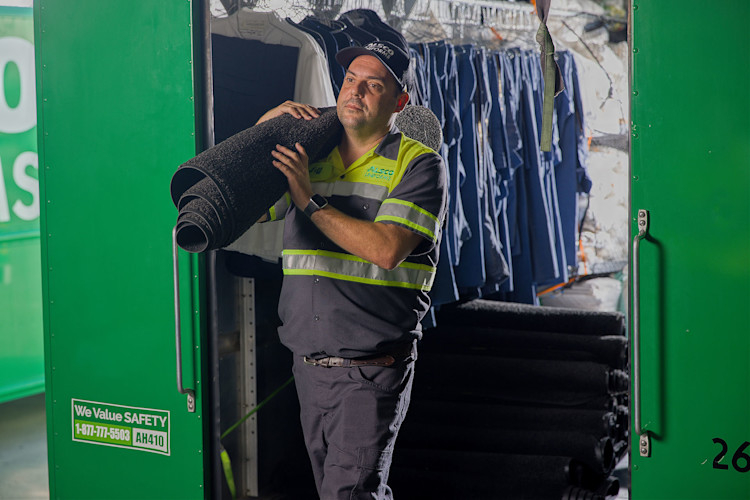
Beyond AEDs and First Aid Cabinets, we also offer floor mats, mops, flame resistant and hi vis uniforms, and PPE to keep your team safe in the workplace. We can also provide linens, uniforms, cleaning products, restroom supplies, and everything else you need for your next shift.
Contact us and we can discuss how we can handle your AED needs.